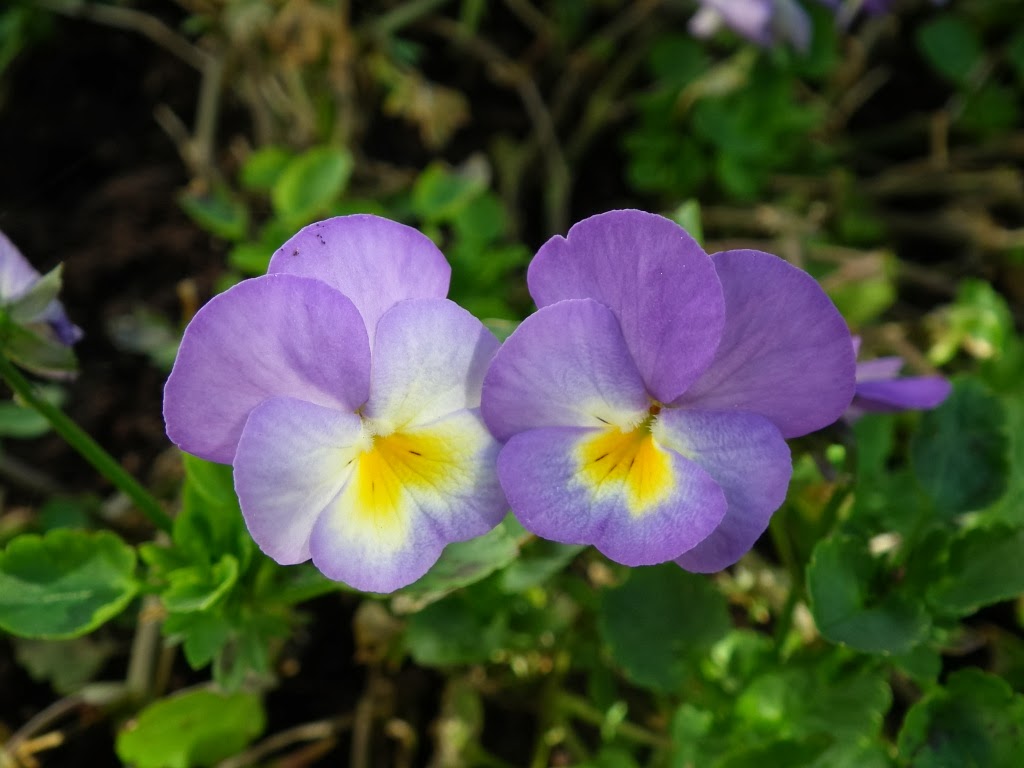
Monday, 7 October 2013

Gnat Attack

Viola 'Ivory Queen'

The rain went away and the sun came back - it is still very warm, around 18 degrees celsius today;  the rain brought with it a plague of compost gnats - which I have only had on houseplants before.  I am treating the ones in the tubs in the same way as I would on houseplants;  I take away the top of the soil - difficult where I have cuttings in the same tub as the mother plant - this is to get rid of any eggs - and then I boil up some decorative stone, wait for it to cool and pour it gently into the tubs.  This work will be done tomorrow if it stays fine, and that should be an end to troublesome gnats.  The gnats got going when I appeared - it is amazing how 'with it' they seemed to be, and recognised the tub owner immediately, but there were little white larvae investigating the air also, and no doubt they will have donned their shiny black mini-jackets by the morning.  They can create havoc with the roots of my violas, though, so I await the morning impatiently.  Meanwhile my naturalist son wants to take a look and make a firm identification ( www.gardenofireland.com), and then gardening son will do the necessary work.  The only drawback is the smiling TV weather forecaster, who said that rain would spread from the west countrywide overnight (it is, after all, damp old Ireland), so we may have to wait a few hours before we can wave goodbye to our unwelcome guests.  The cure should, however, be instantaneous.

Viola 'Irish Molly'
Viola 'Glenholme'
Violas 'Maggie Mott' and 'Helen Dillon' are the worst affected.  Viola 'Glenholme', very close to these two, gleams serenely, and 'Irish Molly', another near neighbour, has also escaped.  'Glenholme' is a wonderful little viola, which holds itself very upright over low-growing foliage; neither wind nor rain seem to affect it.  This viola is supposed to be a seedling from Viola 'Ivory White', and indeed I see the similarity myself in the shape of the flowers, as well as in the sturdy constitution of both.

Two Catalogues from Rodney Fuller
Years ago in Garden News, a British garden paper still going strong, I found an advertisement for a little viola nursery in the UK, owned by Rodney Fuller.  Rodney issued lovely little homemade catalogues, with pressed violas from his stock adhered to the front; here are pictures of a couple of them, from 1983 and 1984.  Those were the days when the European Union was only at an early stage, and you still couldn't bring plants from the UK into Ireland unless the nursery provided a phytosanitary certificate proving the cleanliness and freedom from disease of the plants.  I had a correspondence with Rodney which I treasure to this day, in which he explained how uneconomic his business would be if he had to pay for the inspections necessary to get these certificates.  He joked that one day he would arrive on my doorstep with a bundle of violas for me, but we both knew we were not into lawbreaking.  I recently purchased Rodney's wonderful book on pansies, violas and violettas - of all my viola books I think it is the best.  I will take a picture of it for you for the next blog.  I was very sad to hear some time ago of  Rodney's death - he seemed a gentle soul, and certainly loved his violas.

I will let you know in a few days how it went with the compost gnats.  I just thought of something else - for readers in the U.S., I know it's hard to find named violas, or so I have been told.  Last night I came across a website called Sequim.com, which has quite a nice selection of them for sale - they say they are just putting together their 2014 list at the moment.  2014 !  Spring !  Now that is something to look forward to  :)


Wednesday, 2 October 2013

Admiring From Afar...

The rain came down, yesterday and today, and I am snug in the house, but looking through the windows at the violas.  They are flowering on and on, holding their faces up to the unfamiliar rain; the temperatures are still warm, so they will bloom on, no doubt, for a good few weeks yet.

Viola 'Columbine'
I read on another forum that Viola 'Columbine' was lost in the winter in parts of the U.S.  I only have this viola since this last spring, so I will have to watch it carefully in case we get frost;  it has grown so well and flowered all summer, I would not like to lose it.  Deadheading this plant is not as easy as it is with some; the flower stems are quite wiry and grow very very long as the plant matures;  while with other varieties, a quick nip between finger and thumb is enough to remove the dead flowers, Columbine resists, even though the stalks are thin, and it is only too easy to pull part of the plant up if you use too much pressure in the pull.  Hence I found myself with quite a few unplanned cuttings as early as June and July.  Viola 'Vita', which has a similar habit of growth to Columbine, with similar string-like flower stalks, is much easier to deadhead, for some reason.  If it were not for the lush foliage which supports both these violas, I would imagine that the flowers would lie down in the tubs and not look half so perky as they do.
Viola 'Vita'

Viola 'Etain' still blooming away
It is amazing how different the different viola cultivars behave in many ways.  Some are easy to deadhead, some are difficult like Columbine; some need much more deadheading than others; some produce seed heads quite easily while others only yield four or five over the flowering months.  And the plants even behave differently in different gardens.  I know people who praise fulsomely Viola 'Maggie Mott' for her long and prolific flowering, while with me she flowers for a few weeks, sparingly, and now is just green leaves, not very lush either, although she has been fed and watered just the same as all the other violas.  In a way I love this individuality of the different cultivars, though.  It shows that even plants of the same variety are little personalities in their own right.

Viola 'Cleo', blooming since April
One thing I keep meaning to mention.  When deadheading your plants, make sure to run your finger and thumb right down to the base of the flower stalk before you nip.  Some people do not do this, and leave long stalks which eventually turn brown and dry but do not fall off.  A plant bristling with these redundant stalks is not really very attractive.  Also, I would fear that they might eventually rot and harm the whole plant.  At the top of the blog you can see Viola 'Jackanapes', with just such a stalk.  This occurred, however, because an enthusiastic puppy lopped off the flower just before the photo was taken.  It does serve, however, as an illustration of how not to deadhead.

Saturday, 28 September 2013

Autumn Dreams

Garden Seedling, now lost
I was taking cuttings of several of the violas today, and when lifting the foliage of some, I found lovely healthy little seedlings had sprung up underneath; obviously the seeds don't need a great deal of light to germinate.

A Semi-Double Seedling
This is part of the joy of growing violas - taking cuttings, collecting seed, and dreaming of next spring when these new plants will be appearing.  In the case of the seedlings, there is all the anticipation of seeing the first flowers, and deciding what violas may have parented them.  I am not very organised yet when I collect the seed heads, I don't write down what tub they were growing in or the name of their mother plant.  This is because I am in this for the fun, not for the sole purpose of hybridising.

Black and Purple Seedling
I haven't cut back any of my plants yet, as I am truly reluctant to part with all those glowing flowers, not to mention to thwart the efforts of all the little flies and bees who are visiting them.  Today is a beautiful summer's day in autumn - sunshine, blue skies, temperatures over 20° celsius.


Seedling with flowers of a lovely colour, now tiny


I am posting pictures of four seedlings I had from the last two years.  At least two, the very dark ones, probably had as their parent Molly Sanderson, who then fled with the harsh winter of 2011; I think that viola may not be very hardy, and this impression is furthered by the fact that both these seedlings survived only a year.  I named none of them, as I think it is better to wait and see how the plants will turn out, how sturdy they are, how floriferous and so forth, before endowing them with any title.  The wisdom of this is borne out by the fact that the semi-double viola produced all single flowers in its second year, two seedlings as I said did not survive, and the last of the four, although still here, and as colourful, has produced only very small flowers through the whole summer, after showing in springtime the lovely medium-sized ones it first appeared with two years ago, and which it bore all last year quite effortlessly.


Wednesday, 25 September 2013

The Importance of You, Me, Canaries, Violas

Viola 'Ivory Queen'
There are so many big and important things going on in the world, and there are blogs about them all. What does it serve the world, then, that someone who loves, say, violas, blogs about them?  I have been thinking about this, feeling a little guilty, even, that perhaps pastimes such as growing violas are not of the first importance in the context of wars, hunger, grief.

Viola 'Helen Dillon'
The more I think about this, though, the more I see that to love something from creation is an acknowledgement of that creation.  We are the keepers of the world, and perhaps one small person can only concentrate on one small piece of this beautiful world at a time.  Bigger people do bigger things.

Also, there is no doubt that my love for violas and my enjoyment of them is balm to my soul, just as the love of his canary was to the prisoner of Alcatraz.  And is it not true that most flowers the world over are indeed born to blush unseen? Nevertheless, they live, and there is a reason for that life; and like those of us who are insignificant threads in the large pattern of life, still we are threads in that tapestry, a vital part, no matter how invisible, of the whole.

Violetta 'Zoe'
So, I reassure myself, love on, whether it be the tiniest insect, sparrow or lily of the field, or a viola;  love of these little things in life is a bow to the great Spirit that sustains us all.

I think it must be the simple structure of the viola flower which makes it so attractive to a large variety of insects.  This morning I lifted a leaf of Etain, and a large white moth flew out and away. Even though the day is very overcast albeit quite warm, the hoverflies in their varied colours of jacket are busy around the tubs; as I bend to scrutinise a flower, they pause politely in mid-air, not the least bit intimidated but patient until I pass.  Yesterday there was a bee drunk underneath a flower of Cleo.

The ecosystem is humming with business.  The largeness of life is in all these small beings.

Viola 'Cleo'

Sunday, 22 September 2013

What's In A Name?

You can buy violas almost anywhere plants are sold, that is, the pansies and their tufted cousins, although of course I am talking about garden violas here, but you cannot buy the named varieties everywhere.  Garden centres generally sell seed-grown violas in huge numbers, both in the spring and at this time of the year, for bedding purposes.  What is the difference between the so-called 'named' violas and those grown from seed?  This puzzled me for a good while.  I knew there was something, I could see it, but not say it.  Eventually realisation dawned.

The main difference you will find is in the habit of the viola - the seed-grown ones are very vigorous, very hardy, but not the same as their named cousins.  In the main,  the flower stalks of the named varieties are taller, held well above the foliage; this foliage, as I have mentioned before, tending to spread outwards in a tuft-like manner, not holding together in a clump as with most of the seed-grown plants. In the case of the seed-grown plants, this clump will spread, but the flowers are held close to it, even if they have fairly long stalks. You need to look yourself at the two types to see what I mean. As to scent, those grown from seed often do have it, but the perfume from the flowers of the named ones is usually truly delicious, and rises into the air all round the plants.  Both the plants grown from seed and the named varieties attract all kinds of pollinating insects; today, in the heat of our tropical weather which has come from the Azores, so the weathermen tell us, the air over the violas was teeming with hoverflies, bees, other flies gleaming like jewels that I have no name for, and even the odd wasp, which latter insects do not always seem to be very attracted to violas.

Sorbet Mixed Violas
There is one type of viola grown from seed which often does have tufted foliage and tall flower stalks; I was informed by the sales person in the nursery that they are called Sorbis violas - I have just now discovered that this should actually be 'Sorbet'.  No wonder I couldn't find them online.  At the outset I should say that one box of these violas can embrace several different-looking plants.  Some look rather like the primitive wild pansy, in shape and even at times in size.  Some have a modest scent, some don't.  Some have a very attractive, rounded shape flower, and nice colours, some are more like the ordinary
A Sorbet viola, scentless
bedding violas that have been available for years.  I don't think they could be F1 Hybrids, because of this inconsistency, but I am willing to be proven wrong, because my education in such matters is quite deficient, and I am only learning as I go.

In Lidl I bought a box of mixed bedding violas, and a couple of plants have indeed long flower-stalks, a memorable scent, and very desirable colours; however, the flowers despite the long flower stalks still do not stand out as high as I would like over the foliage, and the leaves are not spreading, but rather make a clump, so that the flowers seem to be studded on the plant rather than dancing above as in the case of the named  'tuftys', which, it seems to me still have not been surpassed by any seed-grown varieties..
An orange Sorbet viola, scented

I am more than willing to admit that plants of the last description are in the end a matter of taste; also that some named varieties do not hold their flower-stalks as high as those of other named plants; nor do all the named varieties run and create offsets so willingly as others.  I will discuss these again.  Suffice it to say for the moment that it is the named varieties of viola that have stolen my heart and remain true to their promise year after year.

On the left is the viola purchased in a mixed box from Lidl.  It is very highly-scented, a beautiful colour, but the flower-stalks, of medium length, hardly clear the foliage, which is in a clump rather than tufted, as with named varieties and in the case of the two Sorbet violas pictured above.
As I said above, not all Sorbet plants show this tufted quality either.

Thursday, 19 September 2013

Preparing for Cuttings

I know that I should be cutting the violas back now, so that they will produce lots of new growth for cuttings and division; however, it is very hard to cut off these beautiful flowers when winter is approaching and there will be less of them anyway;  having said which, some of my plants flowered right up to November last year, so there could probably be two more months of bloom to be had this year, unless we get some freak bad weather.

Viola 'Vita'
I have found some seed heads too, but have not labelled them nor noted which plants they came from this year;  it is very interesting and enormous fun to sow them in spring and see what new plants grow,  This is one of the many joys of growing violas; or indeed any plants, from seed.  They are very easy to grow from seed too, germination seeming to be 100%.

Viola 'Columbine'
Here are some pictures of my plants: the first is Viola 'Vita', discovered by Vita Sackville-West in her garden at Sissinghurst Castle. The pink flowers are small, but it flowers on and on.
Viola 'Columbine' seems to be quite healthy. The flower stems are very wiry, and you have to be careful when deadheading, so as not to take a large tuft of new flowers and foliage at the same time. It has lovely stripy flowers with a beautiful scent.

Viola 'Helen Dillon'
Viola 'Helen Dillon' has recovered from a mildew attack in this picture, but has lost a lot of foliage  in the process.

This plant was actually sold to me in Woodies as Viola 'Etain', but since I already had that plant I knew that name was incorrect.  Graham of the U.K. National Pansy and Viola Society pointed me in the right direction to identify it, and it seems to be Viola 'Helen Dillon', but strangely, not the plant which originally bore this name - just the one that does now.  I am not very clear about all this, so will report back at a later stage when I learn more about it.

Saturday, 14 September 2013

Peace In Our Gardens

Out among the viola tubs today there was perfect peace.  A myriad hoverflies and two or three honey bees were visiting the flowers; from the next door gardens came the joyful shouts of children; as I deadheaded and took in the scent which literally hung in the air, a plane sounded overhead, and suddenly I was thinking of the radio news earlier about Syria.  How privileged I am, to be pottering around here, while all over the world are people who never know this peace.  How different from ours are the lives of children, who hear the roar of planes and bombs and face the threat of death from the skies - all because of the fights of their elders, who should be their guardians instead of being the means of tormenting and shortening their precious early years! Whatever way you look at it, whatever side you are on, where is the good if your struggles for power sacrifice your children?  How could any war be worth the loss of your own offspring!  Surely these wars are the worst kind of child abuse!
Viola 'Etain'
When I sit in the kitchen, I can see through the open door a brown window box overflowing with viola 'Etain'.  This is a lovely yellow viola, with a purple border all round the flower.  It has been flowering since April and shows no sign of stopping yet.  I would take cuttings but I hesitate to disturb it.

Viola 'Aspasia'
'Aspasia'  is a bubbly little viola; its flowers are much smaller than those of V. 'Etain', but the plant is every bit as upright and floriferous, and has an altogether happy appearance.  I have been deadheading all my violas every day if at all possible, and  'Aspasia' is one plant which really rewards this care, although all violas are the better for it.

Viola 'Irish Molly'
I had read about viola 'Irish Molly' before I ever saw her, and when I first spotted her in a nursery it was instant recognition.  No photo can really do this viola justice.  It has a tufted habit foliage-wise, with the flowers held well above the leaves.  But it is the flowers which are unforgettable - in colour they are a mix of brown and greeny yellow, and seem to be regarding one solemnly.  I had this plant for some years and lost it, and now have it again.  According to one catalogue it is considered quite difficult to grow, but I think I lost mine through carelessness, and I shall take care not to do so again.  I remember when I first laid eyes on the low-lying rocks of Connemara, supine at the edge of the green Atlantic, and the time I stood at the Rock of Cashel and saw all Tipperary and beyond spread at my feet and glowing in the sun; that is how it is to look at Viola 'Irish Molly' for the first time - a jewel of a plant which glows at you and dwells in serenity.  But you need to see it in real life, photos just do not do it justice.