Showing posts with label seeds. Show all posts

Monday, 9 December 2013

Growing Better


Viola 'Aspasia', happy in mixed company
Viola cornuta minor last summer

I hadn't realised how much I had missed them until I turned the corner of the house, and there before me were the viola tubs. It was astonishing how green and fresh their foliage was, some holding teardrops from a recent shower.  When I left for a morning visit to a hospital clinic in early November, I fully expected to be back in my little garden by noon. Instead I was transplanted to a room in the hospital, to be scrutinised and analysed and generally brightened up if possible. It was somewhat akin to what happens when we decide that some works needs doing with a plant which is failing to thrive; thankfully the doctors, like myself, seemed to prefer the conservative approach - liquid feeds were deemed better than a good prune, at least for the moment. Now that I am perking up, here I am back to talk about my little plants.

Here we are already in December, and violas 'Etain', 'Columbine', and 'Aspasia' are still flowering; the lovely yellow viola from Lidl is still in bloom, also the two Sorbet violas.  All the cuttings I took in October are green and flourishing, and the cuttings from Tomás are looking happy and even seem in some cases to be increasing. It's 13 degrees celsius today, the mild temperatures no doubt help with the growing.

I am considering sowing the seeds I saved shortly, dying to sow them, in fact, and start off the new growing year.

Has anyone grown a pansy or viola as a house plant, I wonder? If so, I would love to know how they did, whether or not they thrived, if they flowered well, and so forth.  If anyone tried this, I would love to hear about it.

Today's photos are from last summer, because I haven't got any current ones, but I hope I will have some
Viola 'Etain' last May. So far it has been blooming steadily since April
shortly.  Meanwhile, I'm sure you are all up to your eyes getting ready for the coming holidays.  Have fun!

Tuesday, 29 October 2013

Weathering The Weather

Left to right, Violetta 'Zoe' with Viola 'Vita' with Viola 'Cleo' at the back
We were lucky and escaped the terrible winds they got in England and Wales.  I wasn't really worried about the tubs because they weigh tons and it would be a brave wind would move them, but it was one of the times the weather forecasters were right and the storm gave us a miss.  The blowy weather we get this time of year brings bonuses too, such as the lovely fishbox my son brought home to me from the beach a few days ago.  It is in these boxes as well as in sinks and large garden centre tubs that I grow my gardens, including my violas.  They have several advantages, not least being the fact that they need not be disturbed when the rest of the garden is being torn asunder, as is the case with ours now, while gardening son works out his dream design on our half-acre.

Viola'Irish Molly' beside lemon-yellow pansy, Viola 'Aspasia' in front
 
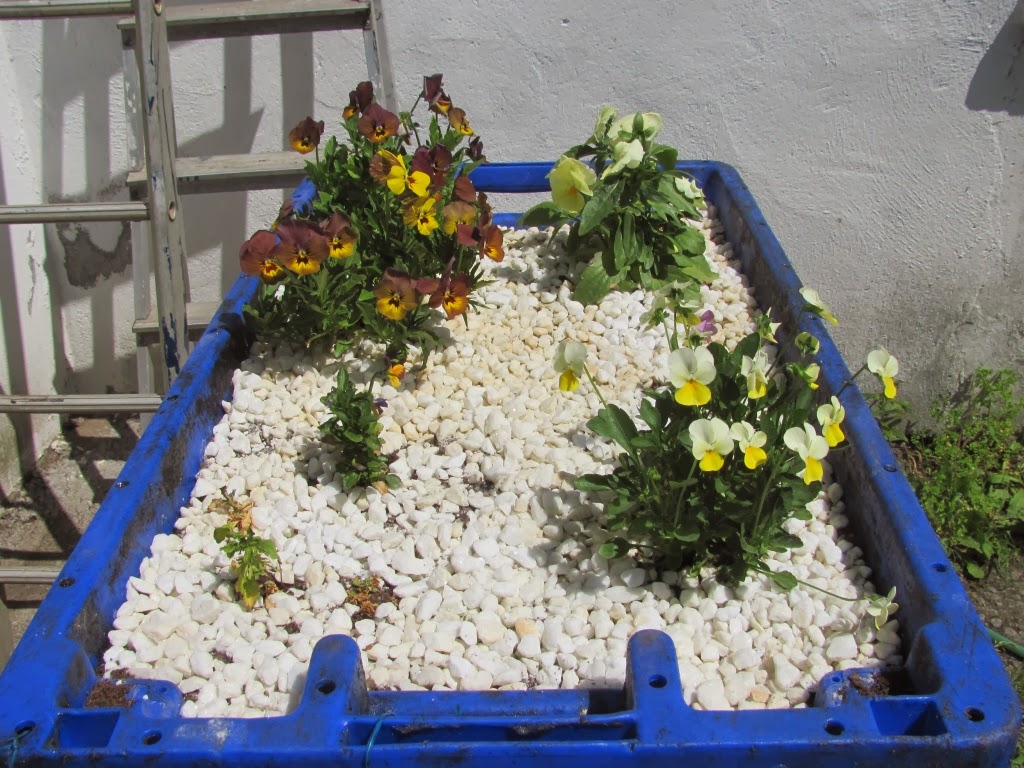
Fishbox with pansies and mixed plants
The photos here were taken in July.  One thing immediately noticeable is that the pansies in them were inclined to wilt in the heat, while the violas seemed to love it.  Interestingly,  violas are not half so affected by rain either, while pansy petals seem much more easily marked by raindrops, and the plants being of a more straggly nature are easily flattened.  That is one thing I have discovered about the Sorbet Orange viola, it may well have lots of pansy ancestry because the rain tears its petals and makes the stems hang lankly.  I wonder if anyone else has noticed that pansy foliage stems seem hollower than those of the viola, which makes them much less supportive of the plants in conditions of heavy rain. I must add that violas and pansies do very well in tubs of mixed plants as well as in ones dedicated to them alone.

Left to Right, Violas 'Helen Dillon', 'Vita', 'Cleo', Violetta 'Rebecca'
Viola 'Zoe' at back of centre tub
Viola 'Sawyer's Black'
Here is a picture of the Sawyer's Black violas from the Ebay seller from whom I bought the seeds.  I'm afraid it is not very clear if you try to make it larger but you can get the general idea of how they will hopefully look.  I would love to know the ancestry of the various seeds on sale, and no doubt there is somewhere online some hints of these can be found. There seems to be a very laid-back attitude to violas and pansies by many sellers - the term pansy and viola seem freely interchangeable particularly on the U.S. websites.

I came across this old book on pansies, violas and violets in a secondhand bookshop some years ago, and found it recently in my store of books having forgotten about it.  It was published in 1898, and therefore lacks the colour plates which so enhance the more recent titles by Rodney Fuller and Roy Genders.  I don't see any familiar viola names in the lists Cuthbertson gives, though he gives lots of information on the origins of the pansy and viola, more or less the same as given in later books. No doubt you could easily stumble across a copy yourself at some sale.  The child who scrawled over many of the pages with an indelible pencil (remember them?) is more than likely now dead.  It reminds me to make the most of the time I still have.  Books are less mortal than we.  


Friday, 18 October 2013

Precipitation and Participation

My New Violas From Tomás
Firstly I want to say thank you to a lovely plantsman who sent me ten shiningly healthy violas in exchange for five of mine, a most generous trade, I'm sure you'll agree.  Trading plants is another joy of gardening, and imagine my delight on opening the carefully packed plants to discover Viola 'Molly Sanderson', which I told you I lost two years ago, nestling amid violas I have never seen, nor in some cases even heard of, before.  How I look forward to seeing them flourish and flower !  Tomás, believe me they are truly much appreciated.

The rain today is that falling straight-down, no-nonsense kind of deluge.  The only way to see my violas is by pressing my nose to the foggy kitchen windows, but I know the plants are probably loving the unexpected precipitation, especially since the temperatures are still around 18 degrees celsius.

Viola 'Columbine' blooming away
Viola 'Etain' October Blooms
The cuttings I took during the last week or so are still perky and greener than green.  I didn't come across one seedhead yesterday as I pottered around the tubs.  It looks almost as if  the bees and hoverflies are taking 'industrial action' (which strangely means the very opposite of how it sounds).  or perhaps it is holiday time for pollinators - I'm sure they can take holidays too, like the rest of us.  There are usually bees (mainly the bumble ones) busy in the garden right through December, so they have hardly gone into hibernation.  Maybe they will all be back with the sun.  There are still many violas in bloom, in some tubs just one or two, while in the case of violas 'Etain' and 'Columbine' the plants are still covered in blossom.  Interestingly, in the case of the latter, there has been a change, in that the deadheads which used to be so hard to remove now just snap off at the base of the flower stem - perhaps there is some kind of seasonal cause for this new behaviour.  I know other growers would fervently urge me to trim all the flowers and foliage off, in the interest of the production of cuttings, and perhaps to give the plants a rest from spending their energies in flowering, but I tend to go with nature in this, and will not be cropping back my plants yet.  Those two violas have been in bloom steadily since early April and are looking very upbeat about it.

Car Boot Sale Viola Book
Here are two more viola books, one by Roy Genders, who has written umpteen books on different garden plants, some on gardening generally, many on specialist plants.  I can't remember where I read the interesting comment that this prolific writer plagiarised his own books constantly in his production of endless garden works, but I have always enjoyed everything he wrote and learned a lot from his books.  The second volume is one I found at a car boot sale, casually thrown into a box of mixed items.  Naturally enough I was instantly attracted by the cover illustration.  It is a small work of some thirty-two pages only, full of common sense.  The illustrations inside are copies of pencil drawings, but very helpful in their clarity.  Look at the cost of this little book !  I paid fifty cents for it,  I will allow someone of more mathematical ability to decide how much its value has inflated or otherwise since its publication.  There is no date on it but I am guessing it is a good few decades old.
Recommended Viola Book
To go back to Roy Gender's book, which is full of good stuff, in his list of viola species he mentions how the species Viola gracilis is very much involved in the ancestry of the garden viola.  The editor of the other book, T.W. Sanders, who I see from the cover was a one-time editor of Amateur Gardening , gets to the question of "what constitutes the difference between a Pansy and a Viola.  Well, first of all, both are Pansies and both Violas; they are merely distinct types of the same genus and species."  Now no-one could dispute that the viola known as 'viola' has a lot of Viola tricolor in its blood, but the horn at the back of its flowers loudly proclaims the importance of its Viola cornuta ancestry.  Other writers stress the participation of Viola lutea in the viola's origins.  It would be wonderful if there were an apt, catchy name for the so-called viola, to halt all the confusion. 

Near the top of this blog, on the right, are  two links.  The top one is to the Viola Tub Forum, and if there is anything anyone would like to say about violas, please feel free to go on and post.  This little forum is literally in its infancy, and if people have anything they would like to say there,  posts would be really welcome.  You can start your own threads, it's not necessary to keep to what I have blogged here.  Eventually we might be able to use the forum to set up viola exchanges, even.  You can write about violas, pansies, viola species, seed sowing, cuttings, varieties, anything, it's your forum.

Viola 'Orange Sorbet' yesterday
The second link is to the website of the National Viola and Pansy Society of Great Britain.  It's a fascinating website, and you never know, you might even be tempted to become a member.  Graham, who runs it, is a goldmine of viola information and enthusiasm.  I have not the competitive urge myself, but I know some people would really enjoy growing and showing plants if they got into it, and for this reason alone the society would welcome you with open arms.  If, like me, you just want to grow violas for the sheer interest and love of them, you will still find a lot to inspire you in the NVPS, which is almost one hundred years old now.

I don't know if it's raining where you are, but we have had more than enough now, thank you. Maybe when I write again the sun will be shining down on us and our violas.


Viola 'Aspasia' enjoys the October sun. The sticks are to deter a determined cat

Saturday, 12 October 2013

Cooler Days

Even though I have not been out deadheading so much lately, there are very few seedheads,  the pollinators having obviously been deterred by the suddenly cooler weather.  Today I sat in the kitchen with the Stanley cooker glowing and burping gently beside me, and sorted through my saved viola seeds.  How amazing to consider that each tiny hard seed is a potential viola of goodness knows what colour or habit, that will raise its leaves and flowers to bask in next summer's sun.  I look at my seed trays and ponder whether to sow some now, or wait until spring.  I have read that the saved seed has a short shelf life.  Yet all 2011's seeds overwintered in the kitchen in a sealed jar, and very many germinated when sown in the spring of 2012.  I saved none in 2012, as the crop was very sparse, on account of the tubs along with the whole garden undergoing the upheaval of a total makeover which is not completed yet.

In the white sink - Viola 'Molly Sanderson'
I saw some seeds of a black viola called 'Sawyer's Black' on Ebay, and couldn't resist them.  They arrived last week and, if their picture is anything to go by, they should be lovely.  What seed strain they are from I cannot tell despite hunting all over the web for the information.  I really look forward to seeing if they are anything like Viola 'Molly Sanderson', a low-foliaged totally black viola which I lost two years ago in the unusually cold winter and have not got around to buying again yet.

The thing about having a special plant in your life is that even if the weather is very bad and you can't get outside comfortably, there is so much to read about, to study.  The year that rolls on for me is a viola year indoors and out.  Even general garden writers have words to say in passing about the viola, and herbals also talk about them, since they are edible and have many therapeutic uses which older gardeners knew about.  You never know what you will find said about them. 

Here are two books by the late Rodney Fuller.  The larger one is packed full of information and advice on the care and cultivation of pansies, violas and violettas, including their history and how they differ from one another; there are lists of all the known species, but better still of all extant varieties and cultivars with a succinct description of each one.  The centre of the book has pages and pages of colour photos of many of these plants which is a great help particularly to a beginner.

The smaller book is a little work of art; it describes a mere thirty varieties of garden violas and violettas, and there are entrancing illustrations by the artist Elizabeth Dowle.  This little book would easily fit in your pocket or handbook, to dream over on the bus or train or while in a queue at the doctor's.  Both books are readily available on Amazon and no doubt on many other bookselling sites, and are a delight for anyone into violas.

I suppose some people might be wondering by now about the difference between the viola and the violetta.  Basically it is a question of origin, both having been hybridised in the 1800s by different growers, and although they are said to be different in appearance, personally I find no difference except that which exists between viola varieties in general. The violetta is reputed to be smaller, with the flowers always scented and having absolutely no rays or whiskers on their faces.  However, that description also fits many violas, and I am sure that they interbreed, so the giving of separate names to them is a little of a puzzle.  Violettas 'Rebecca' and 'Zoe' are very unalike to me, for instance, and both much more resemble other viola cultivars than each other.  Perhaps in time it will become clearer.  I really think of them all as violas, to be honest.

Thursday, 19 September 2013

Preparing for Cuttings

I know that I should be cutting the violas back now, so that they will produce lots of new growth for cuttings and division; however, it is very hard to cut off these beautiful flowers when winter is approaching and there will be less of them anyway;  having said which, some of my plants flowered right up to November last year, so there could probably be two more months of bloom to be had this year, unless we get some freak bad weather.

Viola 'Vita'
I have found some seed heads too, but have not labelled them nor noted which plants they came from this year;  it is very interesting and enormous fun to sow them in spring and see what new plants grow,  This is one of the many joys of growing violas; or indeed any plants, from seed.  They are very easy to grow from seed too, germination seeming to be 100%.

Viola 'Columbine'
Here are some pictures of my plants: the first is Viola 'Vita', discovered by Vita Sackville-West in her garden at Sissinghurst Castle. The pink flowers are small, but it flowers on and on.
Viola 'Columbine' seems to be quite healthy. The flower stems are very wiry, and you have to be careful when deadheading, so as not to take a large tuft of new flowers and foliage at the same time. It has lovely stripy flowers with a beautiful scent.

Viola 'Helen Dillon'
Viola 'Helen Dillon' has recovered from a mildew attack in this picture, but has lost a lot of foliage  in the process.

This plant was actually sold to me in Woodies as Viola 'Etain', but since I already had that plant I knew that name was incorrect.  Graham of the U.K. National Pansy and Viola Society pointed me in the right direction to identify it, and it seems to be Viola 'Helen Dillon', but strangely, not the plant which originally bore this name - just the one that does now.  I am not very clear about all this, so will report back at a later stage when I learn more about it.